

Why are wedding rings worn on the left hand?
Blame a Roman love myth and a 16th-century prayer book. The full story runs from ancient Egypt to the jewelry ads that put a band on the groom.

This post contains affiliate links. We may earn a commission on purchases made through our links at no additional cost to you. Learn more.
The short version
- The left-hand custom traces back to the ancient belief in a vena amoris, or “vein of love,” said to run from the fourth finger of the left hand straight to the heart.
- That vein doesn’t exist. It’s a romantic idea, not anatomy.
- In the English-speaking world, the 1549 Book of Common Prayer locked in the left hand for wedding ceremonies.
- Plenty of countries still wear wedding rings on the right hand, including Russia, Germany, Norway, Austria and India.
- Men’s wedding bands only became the norm in the U.S. around World War II.
If you’re in the U.S., the UK or most of the English-speaking world, your wedding ring almost certainly lives on the fourth finger of your left hand. It feels like a rule that has always existed. It hasn’t. Where the ring goes has changed with religion, culture and even advertising, and the reason we settled on the left hand has more to do with a myth about the heart than anything practical.
Here’s how the tradition took shape, where it doesn’t apply, and why the only right answer for your own ring is the one that works for you.
01 / The mythThe “vein of love”
The most famous explanation is the vena amoris, Latin for “vein of love.” Ancient Romans believed a vein ran directly from the fourth finger of the left hand to the heart, which made it the obvious place to wear a symbol of love. The idea is often traced back even further, to Egyptian anatomists who, according to Mental Floss, falsely believed a nerve connected that finger to the heart.
It’s a lovely story. It’s also wrong. The veins in your hand don’t give the fourth finger any special line to your heart. But a good myth outlives the facts, and this one stuck for about two thousand years.
A love story told through anatomy that happens to be completely wrong, and we kept it anyway.
02 / The timelineHow the left hand won
A ring, maybe
Egypt is often named as the birthplace of the wedding ring, though Discover Magazine notes the ring’s true origins are obscure and that there was no formal marriage ceremony in Egypt before the Ptolemaic era.
Iron before gold
Pliny the Elder described an iron ring given to a woman at her betrothal. Silver and gold rings became common by around the third century AD, according to Discover. The vena amoris belief took hold here too.
The prayer book makes it official
Thomas Cranmer’s Book of Common Prayer placed the wedding ring on the fourth finger of the left hand (Mental Floss). The 1662 edition still instructs the groom to put the ring “upon the fourth finger of the Woman’s left hand” (1662 service text). As English-speaking churches spread, so did the custom.
Grooms get a ring too
For most of history, only the bride wore a band. Jewelers tried and failed to sell men on engagement rings in the 1920s, then focused on men’s wedding bands instead. Double-ring ceremonies went from about 15 percent at the end of the Depression to 80 percent by the late 1940s, helped along by World War II (JSTOR Daily).
Your call
The left hand is still the default in the U.S., but plenty of couples choose the right hand, a different finger, or a second everyday ring. There’s no rule you can break here.
03 / Around the worldLeft hand, right hand, or both
The left-hand tradition is far from universal. According to Zola, here’s how it breaks down in many places:
The fourth finger of the left hand, a custom spread by the Book of Common Prayer.
Also common across Eastern Europe and Orthodox Christian traditions. In India, the left hand has traditionally been considered unlucky.
In Jewish tradition and in countries such as Brazil, Turkey, Lebanon and Syria, the ring is worn on the right hand before the wedding and moved to the left after.
04 / Real lifeDoes it matter which hand you choose?
Not really. The tradition is about symbolism, and you get to decide what your ring symbolizes. Some people wear it on the right because they’re left-handed, because of a family or cultural custom, or because the left hand takes a beating at work. Some wear the ring on a chain while they work out or travel, and plenty of couples keep a second, tougher ring for everyday wear.
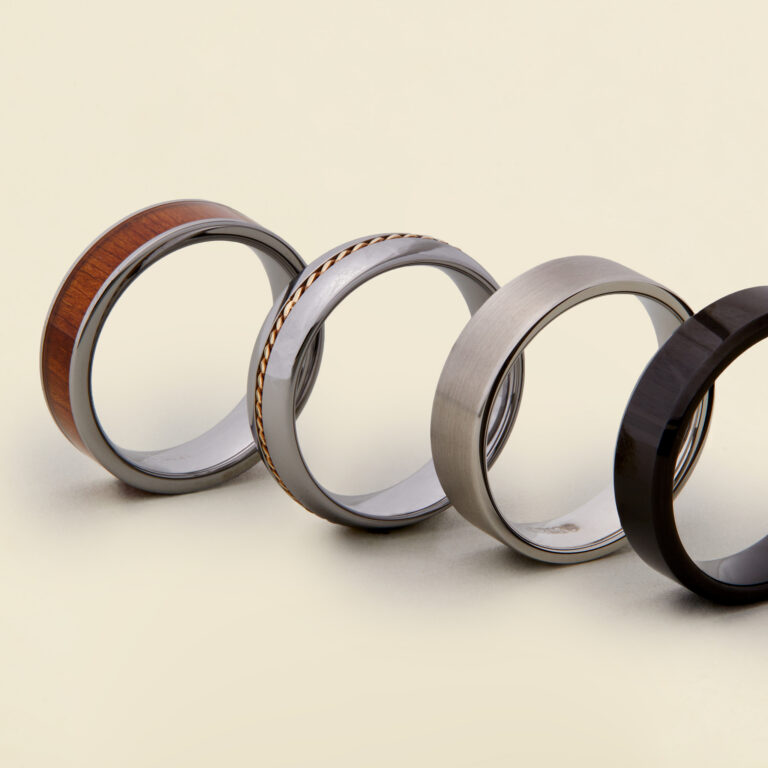
If you work with your hands or spend a lot of time at the gym, a silicone wedding band makes a comfortable backup to a metal ring. If you want something durable that still looks like a classic band, our guide to tungsten wedding bands is a good place to start.
05 / FAQQuick answers
Which finger is the ring finger?
In the U.S. and most English-speaking countries, it’s the fourth finger of the left hand, the one between your middle finger and pinky.
Do the engagement ring and wedding band go on the same finger?
In the U.S., usually yes. Many people wear the wedding band first, closest to the hand, with the engagement ring stacked on top, but there’s no wrong order.
Is it bad luck to wear a wedding ring on the right hand?
No. In many countries the right hand is the traditional choice, and in some cultures it was the left hand that was considered unlucky.
Have men always worn wedding rings?
No. In the U.S., men’s wedding bands only became standard around World War II, when double-ring ceremonies jumped to about 80 percent of weddings by the late 1940s.
Can I wear my wedding ring on a different finger?
Absolutely. Comfort, work and personal meaning all count. The finger matters far less than what the ring means to the two of you.
Sources
Find the right ring.



Dustin is the founder of Weddings to the Wire, which he started in 2017 while planning his own $15,000 backyard wedding. He writes about budget-conscious wedding planning, vendor recommendations, and the questions couples actually ask.